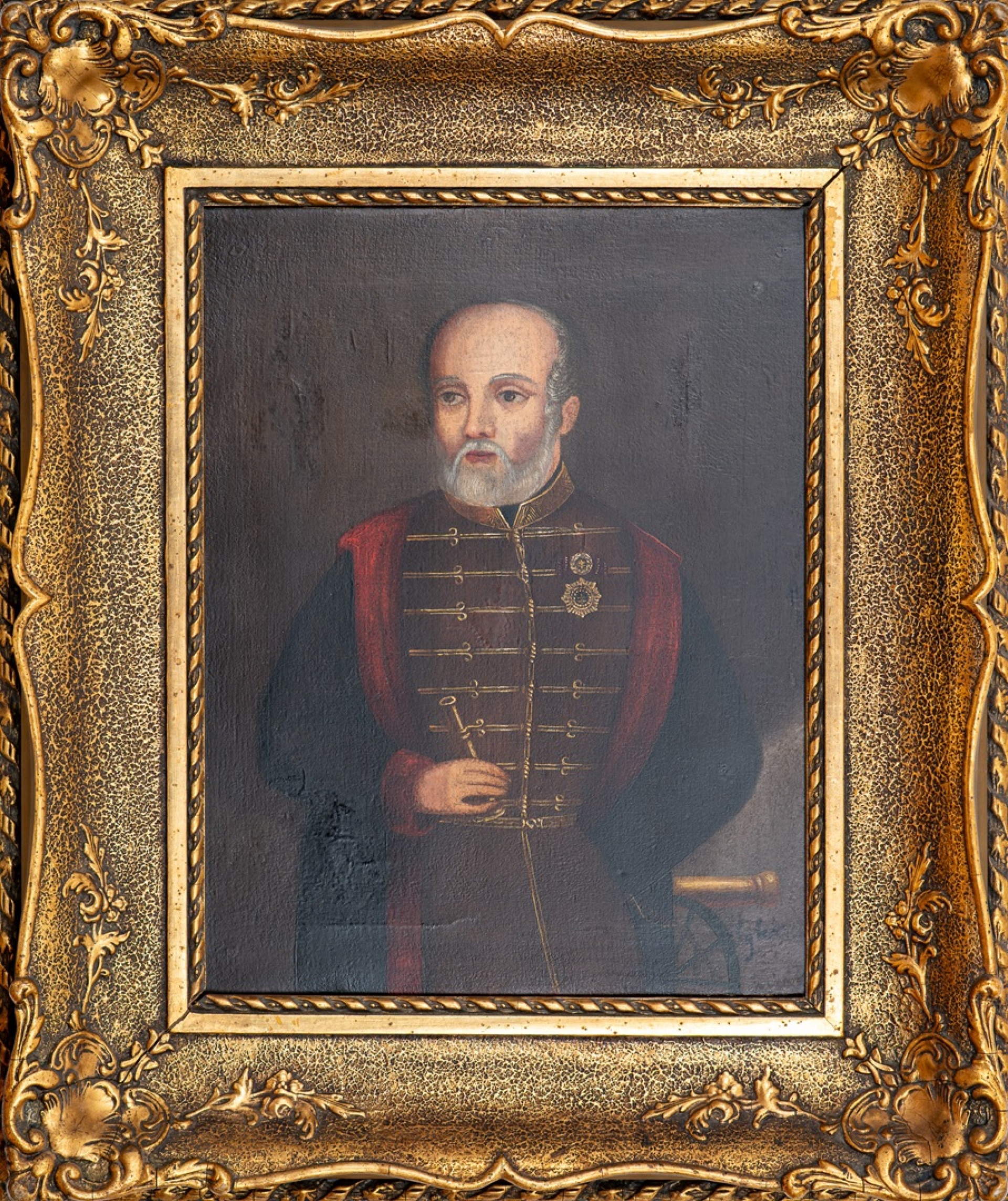
Oil on canvas
57 x 47 cm
inv. no. 7642
The object of the month for March was chosen in honor of the 1848–1849 Revolution and War of Independence. At the same time, the painting is the museum’s most recently restored artwork. It is a creation of Sikó Miklós (1818–1900), who was regarded in his time as a well-known and respected Transylvanian painter. Except for a few months spent in Munich and visits to Pest, he lived his entire life in Transylvania. He painted exclusively portraits; no other themes appear in his oeuvre.
He was a self-taught artist who received only one month of professional mentorship during his lifetime, under the guidance of Barabás Miklós. Although he came from a distinguished family, due to his artistic temperament and a marriage considered beneath his rank, his father disowned him, and he had to support himself through painting.
Following the fashion of the era, he painted miniature portraits on ivory, achieving considerable success. These bust portraits were created on small panels measuring five to six centimeters. In his youth, he worked almost exclusively in watercolor, and even after abandoning miniature painting, he continued to work solely in watercolor for a long time, becoming a true master of the technique. His oil paintings were less successful. The larger scale and the different pace required by the technique may have been unusual for him. Nevertheless, he remained devoted to portraiture, and his oil works thus became rather mediocre, lacking strong painterly qualities, their main value lying in their faithful likeness.
In the 1850s, he undertook commissions together with Vastagh György: Vastagh painted the portraits, while Sikó was responsible for the miniature details. These collaborative works became more painterly pieces.
The oil portrait of General Bem, created around the mid-19th century, is a representative portrait of historical value, executed in the academic style of the period. According to older sources, at the time it was considered the only portrait of Bem painted in Transylvania.
The painting is dominated by dark, restrained tones, while red and gold details frame the decorations. With its smooth, controlled brushwork, it conforms to the style of official portraits of the era.
The artwork was placed in a richly decorated frame adorned with vegetal motifs and Baroque elements, emphasizing the significance of the portrait.