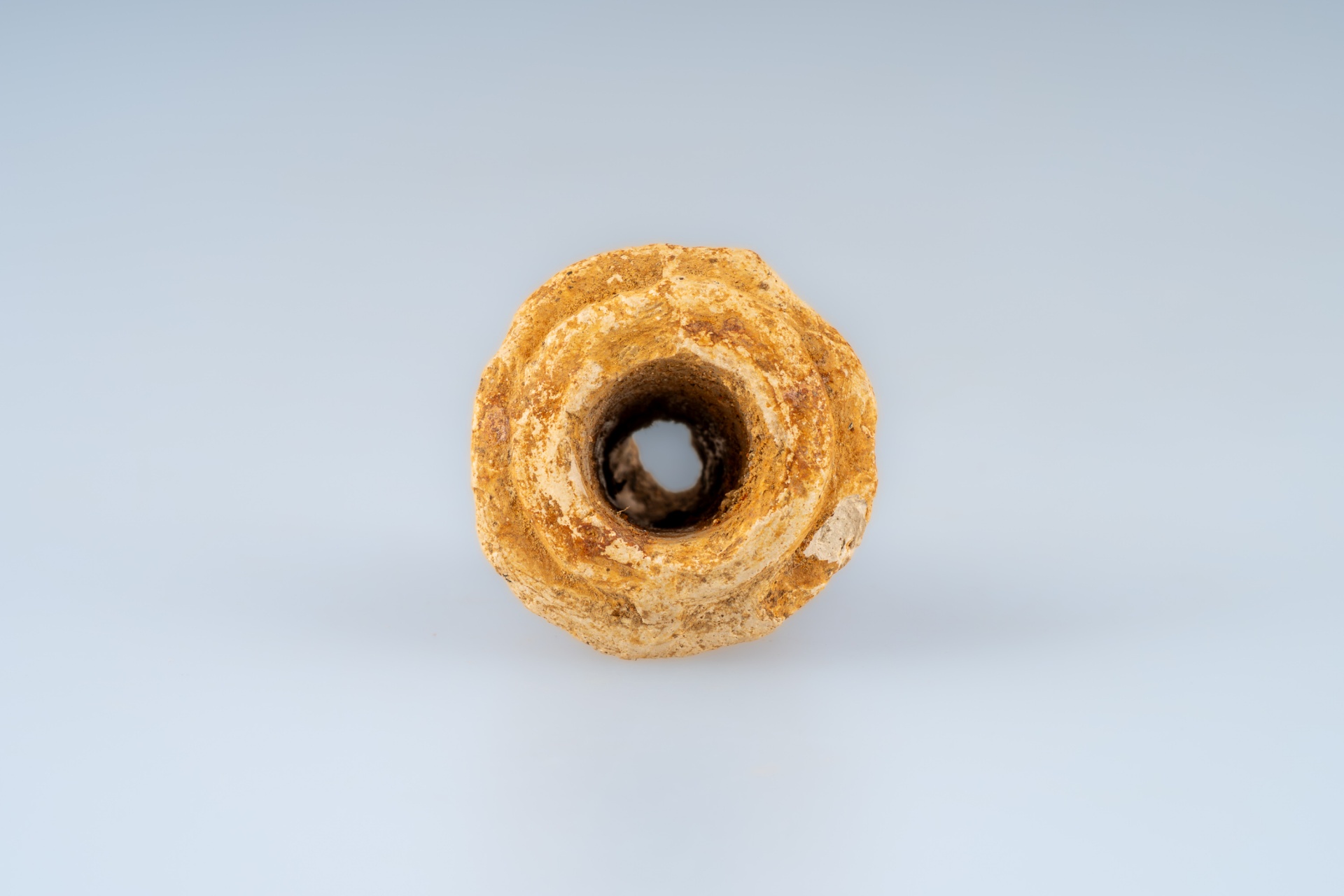
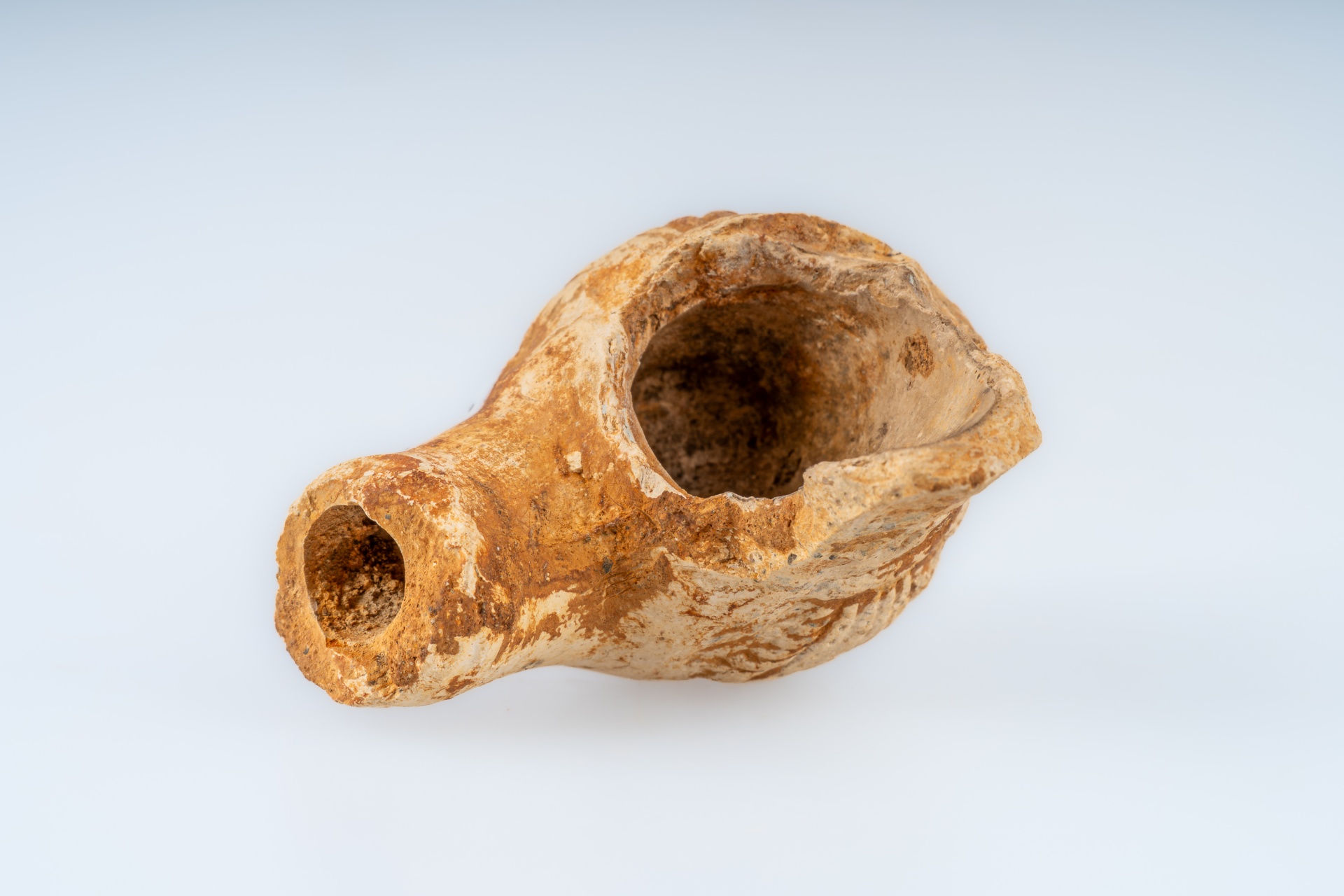
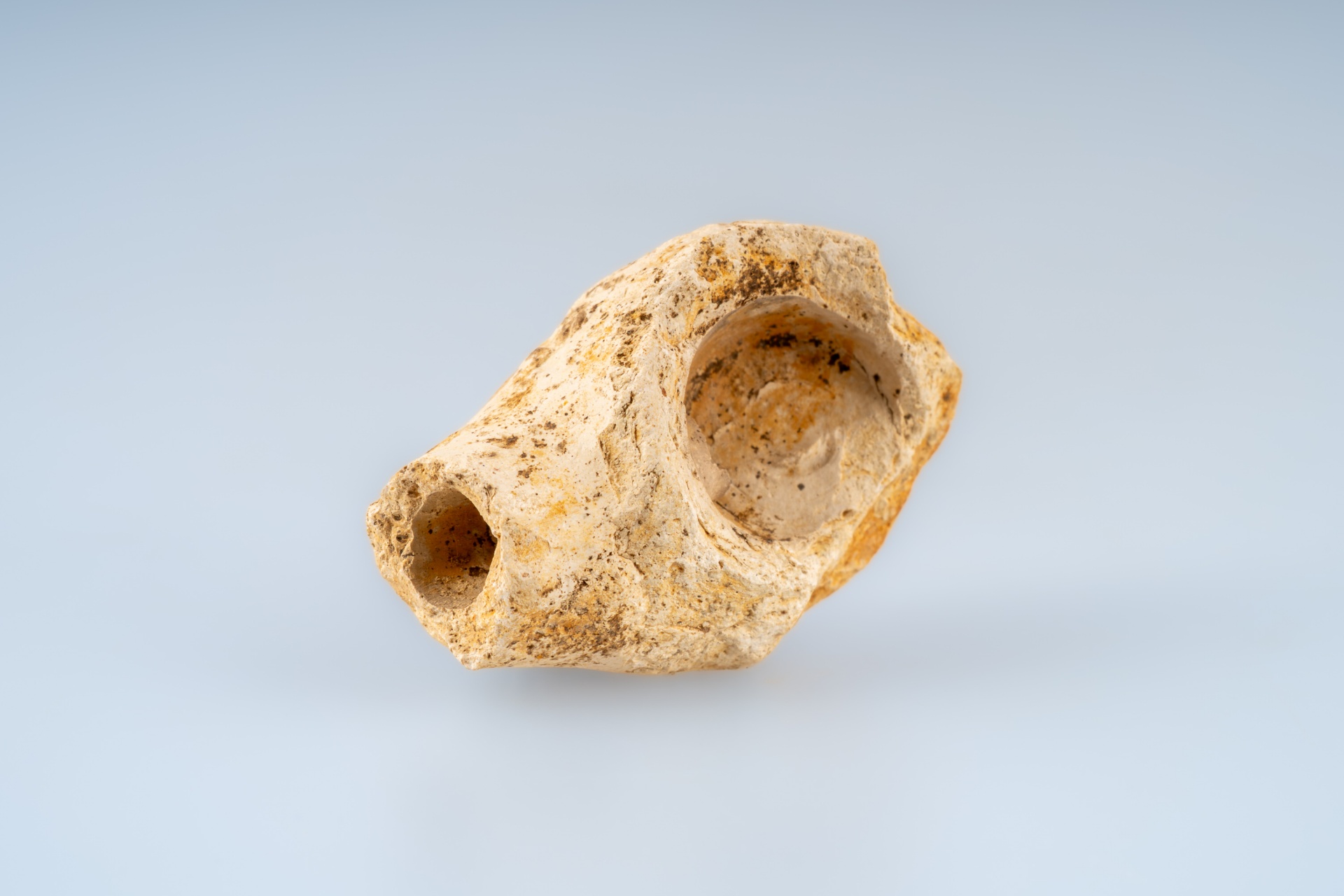
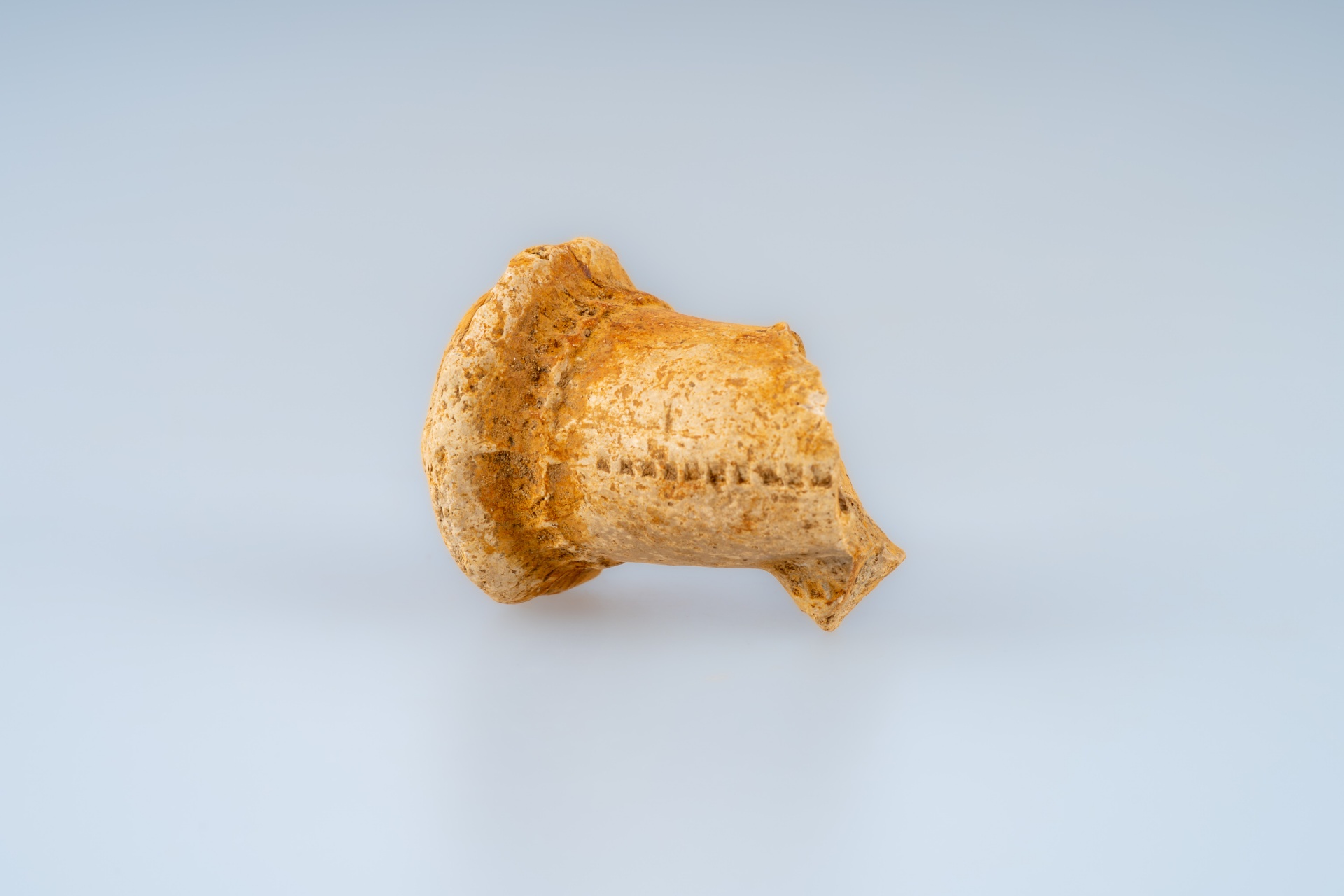
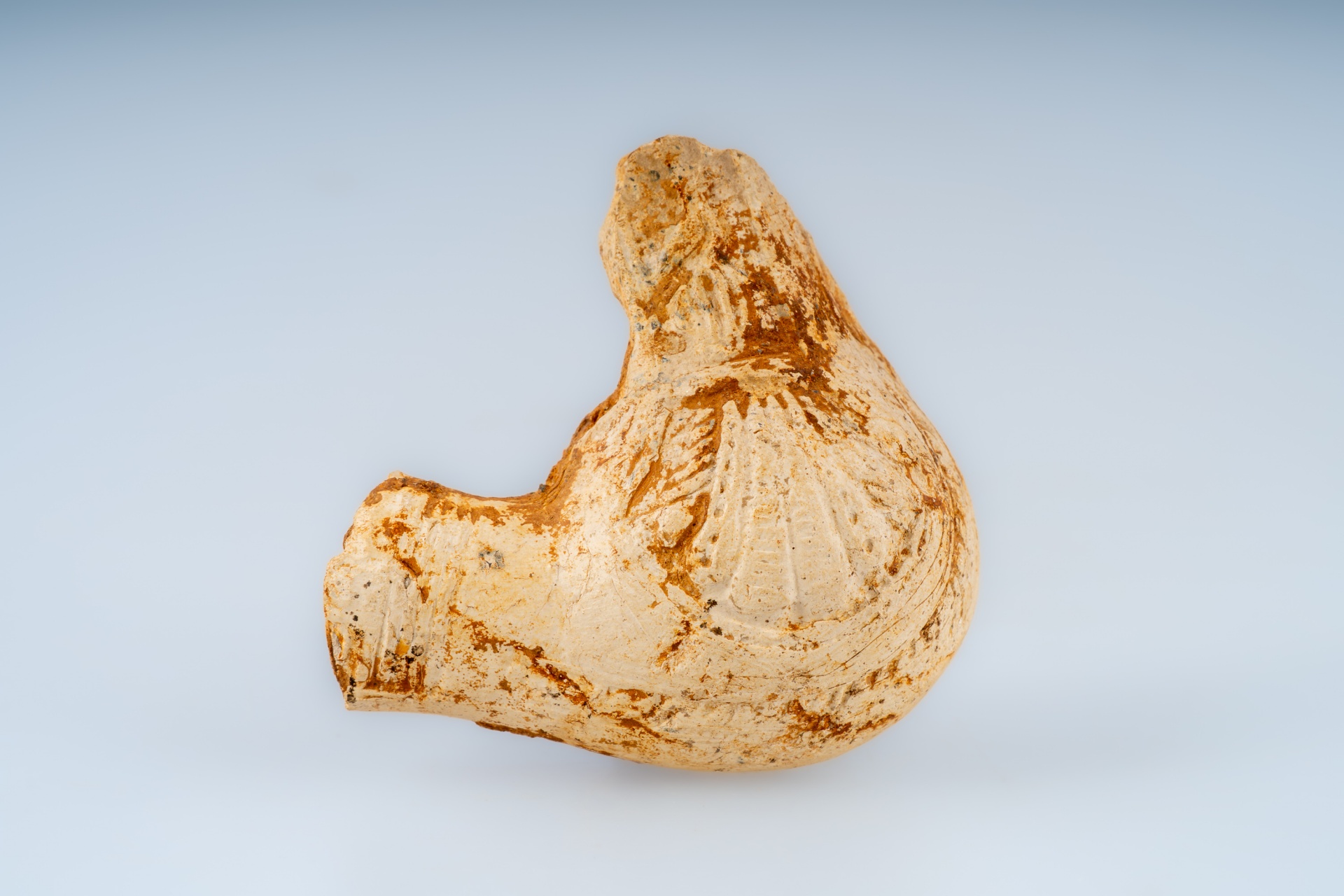
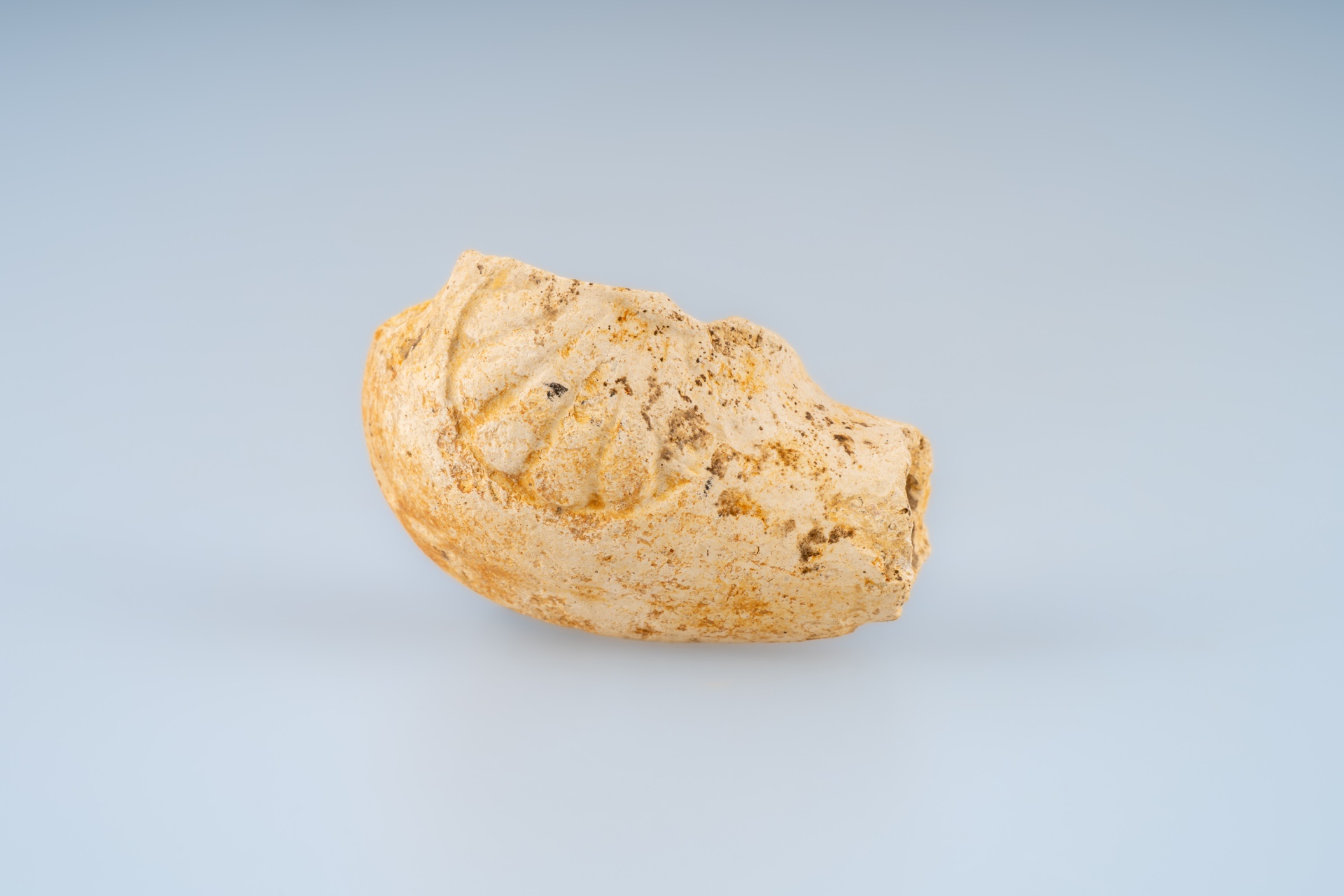
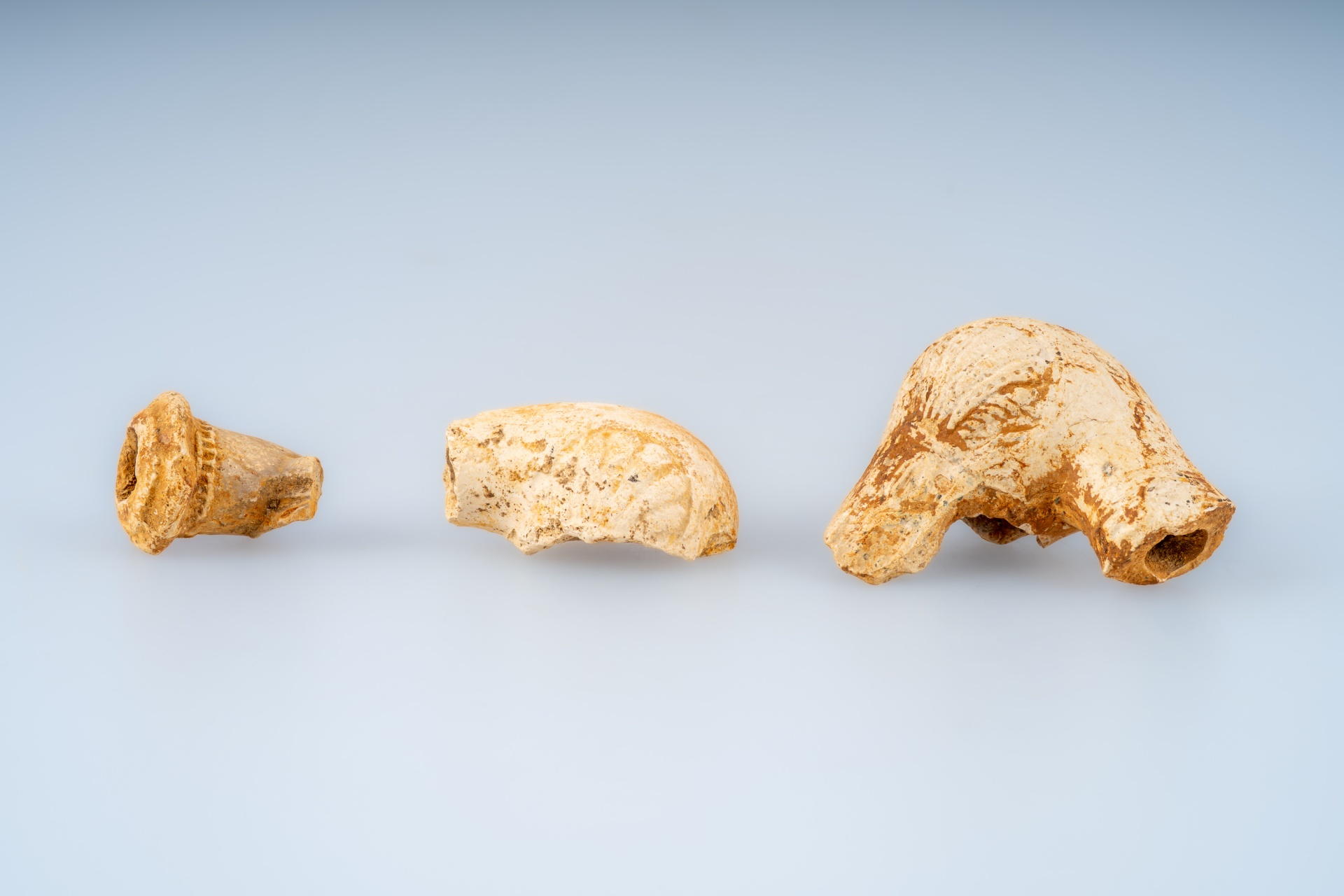
As the Object of the Month for August, the month in which the exhibition “In the Shadow of the Crescent – Transylvania and the Ottoman Empire” opens, we present Ottoman-type clay pipe fragments decorated with a shell motif, discovered during archaeological excavations carried out at Mikó Castle.
The clay pipe was only one part of the smoking implement: the bowl, made of fired clay, was fitted with a wooden stem called çubuk (pronounced chiubuk in Ottoman Turkish). Both the name of tobacco (duhán; Hungarian dohány) and the culture of pipe smoking were essentially adopted by the Hungarians from the Ottomans. Archaeological research conducted in Transylvania and in territories that were under Ottoman occupation has brought to light numerous Turkish-type clay pipes dating from the 17th and 18th centuries.
Pipe smoking became widespread during the reign of Principle George Rákóczi II (1648–1657) and in the period of intense military conflicts against the Ottoman Empire. The main promoters of this habit were Transylvanian and Kuruc soldiers, who were not forbidden to smoke on the battlefield. In the language of the time, the practice was not called “smoking” but rather “drinking smoke.”
The first description of tobacco in the Hungarian language was written by the Reformed pastor Márton Szepsi Csombor, the author of the first travel account composed in Hungarian. Drawing on his experiences in the Low Countries, he warmly recommended the plant to his readers. In his view, tobacco was an effective remedy against hunger and provided a cheaper form of intoxication than alcoholic drink:
“Tobacco is a word of Spanish origin, and in Latin this plant is called Herba Nicotiana, after the man who first discovered its usefulness. It is brought from the New World and has the following uses: if someone sets out on a sea voyage or travels through wilderness where no bread can be found, let him take a piece, light it, and inhale its smoke; thus he may remain for many days without food or drink, feeling neither hunger nor thirst, and may carry out all his affairs as if he had just risen from a plentiful supper. And if a man wishes to become intoxicated and would spend money on raisin wine, ordinary wine, or other drinks for that purpose, let him instead buy tobacco worth only a few coins and use it for a quarter of an hour; I assure him that he will become so intoxicated that even if he had spent four or five forints on drink, he could scarcely have become more drunk.”
The court of the Principality of Transylvania maintained close relations with the Ottoman Empire, from which it adopted not only tobacco itself but also the culture of its consumption. At the principality’s court, the pipe and coffee became indispensable elements of diplomatic negotiations and audiences. Receiving Ottoman envoys was unthinkable without offering them high-quality tobacco. The principles of Transylvania frequently received, and in turn presented as gifts to foreign diplomats and leading nobles, luxurious Ottoman pipes adorned with precious stones, long pipe stems (çubuks), and fine tobacco.
The attitude of the Transylvanian principles toward smoking varied considerably, ranging from curiosity and enthusiasm to temporary prohibition:
- During the reigns of Gabriel Bethlen and George Rákóczi I, tobacco was regarded primarily as a curiosity and a medicinal remedy. Court apothecaries prescribed it for headaches, toothaches, and the treatment of wounds, while pipe smoking itself was still viewed with suspicion within the principality’s court.
- During the reign of George Rákóczi II (1648–1657), pipe smoking became widely established. The principle himself was a regular smoker, and members of his household—including young noblemen and his personal guard—quickly adopted the habit. From this period onward, purchases of tobacco appear regularly in the court's financial records.
- Michael Apafi I became the best-known pipe-smoking principle in Transylvanian history. At his court, smoking became an everyday practice. Apafi was famous for spending hours with his councillors, smoking his pipe while drinking beer or wine. Specially appointed servants were responsible for cleaning and packing the principal's pipes. In 1663, after suffering acute nicotine poisoning caused by excessive tobacco consumption—which left him unconscious—Apafi temporarily banned the use of tobacco. Nevertheless, his addiction proved stronger, and after some time he resumed smoking.
At first, smoking was considered an expensive luxury and was therefore a privilege reserved for wealthy nobles and members of the aristocracy. In the financial records of the principality’s court, tobacco was usually accounted for in Hungarian forints and denars, while purchased quantities were measured in pounds (1 contemporary pound ≈ 0.56 kg) or ounces. By the mid-seventeenth century, one pound of high-quality Turkish tobacco cost between 2 and 6 forints. By comparison, a fattened pig at the time was worth only 2 to 3 forints. Purchasing a single pound of tobacco could therefore amount to several weeks' or even a month's income for an average person.
The court accounts clearly distinguished between different grades of tobacco. The most expensive was always the finely cut, aromatic Turkish tobacco imported directly from Constantinople or from the Ottoman-controlled territories of the Kingdom of Hungary. Towards the end of the seventeenth century, locally grown and lower-quality tobacco began to appear on the market and was consequently recorded at considerably lower prices.
The accountants of the principality’s court recorded tobacco and its accessories under various categories of expenditure:
- The most frequent entries were related to the arrival of Ottoman or Tatar envoys. The records show that the principality’s administration regularly purchased tobacco and expensive pipes to present to the “Turkish lords” as diplomatic gifts or for use during official negotiations.
- During the first half of the seventeenth century, purchases of tobacco often appear in the accounts of the court physician or apothecary. Since tobacco was prescribed for headaches, wound disinfection, and the treatment of asthma, it was acquired not as a luxury commodity but as a medicinal substance, regarded as beneficial for both body and soul, and was therefore purchased at a relatively high price per ounce.
- By the reign of Principle Michael Apafi I (1661–1690), the accounts regularly recorded purchases intended for the everyday consumption of the principality’s household. Entries such as “Paid for tobacco and pipes for His Highness...” appear frequently, alongside expenses for the repair, cleaning, and maintenance of the principle's pipes.
The presented white clay pipe fragments have a lightly burnished surface achieved by smoothing. Their short, curved neck is cylindrical in shape and decorated with a broad, raised collar. The bulbous, almost spherical bowl is ornamented on both sides with a shell motif.
Based on a pipe mold preserved in the collection of the Hatvany Lajos Museum, it is possible to reconstruct the manufacturing process of these objects. A rod of clay was shaped into the form of the future pipe and gently bent into an L-shape before being placed inside the mold. The two halves of the mold were then pressed tightly together, and the clay was pierced through two lateral openings to create the hollow interior of the pipe. Once removed from the mold, the pipes were placed in a vessel and fired in a kiln, acquiring their final shape and durability.
https://hatvanymuzeum.net/index.php/hirek-rendezvenyek/568-tuzben-szuleto-fustben-lelegzo-regiseg-a-csereppipa
Curiosity:
The Hungarian regional word csubuk, used in the Hungarian dialects of Transylvania, entered the language through Romanian, while its ultimate origin lies in Ottoman Turkish. In everyday speech among the Hungarians of Transylvania, the term refers to a tip, gratuity, extra income, or even a bribe.
The word derives from the Romanian ciubuc, which carries the same meanings: tip, gratuity, or additional earnings. Romanian, in turn, borrowed it from the Ottoman Turkish çubuk (pronounced chiubuk), a word that originally meant shoot, stick, or rod, and by extension the stem of a tobacco pipe or its mouthpiece.
Over time, the meaning of the word shifted. Çubuk also came to denote the small payment given to the servants who filled and lit pipes—literally, “money for the pipe.” Through the Balkan languages, the term entered Romanian with the abstract meaning of tip, gratuity, or bribe, and from Romanian it was subsequently adopted into the Hungarian dialects of Transylvania.